

How Attendance, Leave and Overtime Policies Affect Payroll Processing
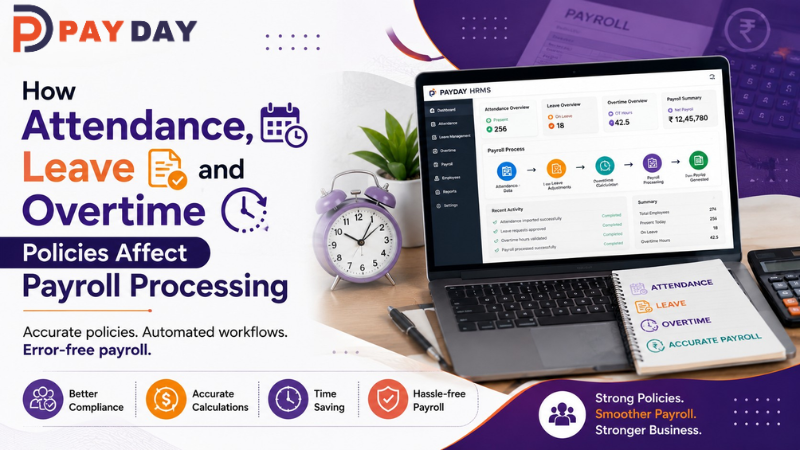
How Attendance, Leave and Overtime Policies Affect Payroll Processing
Payroll is one of the most important responsibilities of an HR department. Employees expect their salaries to be calculated accurately and paid on time every month. However, payroll processing is not limited to basic salary calculations. Factors such as attendance, approved leave, overtime, deductions, bonuses, and working hours can directly influence an employee's final salary.
This is why having cleaAttendance Management, Leave and Overtime Policies is essential for every organization.
When these policies are unclear or managed manually, businesses may experience incorrect salary calculations, payroll delays, employee disputes, and additional administrative work. An integrated HRMS solution such as PAYDAY HRMS helps businesses connect attendance, leave, overtime, and payroll data within one centralized system.
In this article, we'll explore how attendance, leave, and overtime policies affect payroll processing and why businesses should connect these HR processes for more accurate salary management.
What Is a Payroll Policy?
A payroll policy is a set of company rules that defines how employees' salaries are calculated, processed, and paid.
A well-defined payroll policy may include:
- Salary processing dates
- Payroll cut-off dates
- Working hours
- Attendance rules
- Leave rules
- Overtime eligibility
- Salary deductions
- Bonuses and incentives
- Arrears
- Benefits
- Payslip generation
- Payroll approval procedures
The payroll policy should work together with the organization's attendance, leave, and overtime policies.
For example, if an employee takes unpaid leave, the payroll system needs accurate leave information to calculate the appropriate salary adjustment.
1. How Attendance Policies Affect Payroll
Attendance is one of the most important inputs in payroll processing.
A company's attendance policy normally defines working hours, late arrival rules, early departures, absence rules, shift timings, and attendance requirements.
If attendance records are inaccurate, payroll calculations can also become inaccurate.
Common Attendance Rules That Affect Payroll
An organization may define:
- Standard working hours
- Shift timings
- Late arrival rules
- Early departure rules
- Half-day attendance
- Full-day absence
- Weekly offs
- Holiday schedules
- Overtime eligibility
- Attendance cut-off dates
These rules can directly affect an employee's salary.
Example
Suppose an employee is required to work eight hours per day. If the employee has several unauthorized absences during the month, the payroll team may need to calculate salary deductions according to company policy.
If attendance is tracked manually, calculating these adjustments can take considerable time.
How PAYDAY Helps
PAYDAY's Attendance Management module helps businesses maintain centralized attendance records and connect attendance information with payroll processing.
This reduces the need for HR teams to manually transfer attendance data into payroll.
2. Attendance Data Helps Improve Payroll Accuracy
Payroll teams need reliable attendance information before processing monthly salaries.
Important attendance information may include:
- Present days
- Absent days
- Half days
- Late arrivals
- Early departures
- Overtime hours
- Shift information
- Holidays
When this information is available in a centralized system, HR teams can process payroll more efficiently.
PAYDAY HRMS connects attendance information with payroll, helping reduce repetitive data entry and the possibility of manual calculation errors.
3. How Leave Policies Affect Payroll
Leave is another important factor that can influence payroll.
Every organization should clearly define which types of leave are paid, unpaid, or subject to specific conditions.
Common leave categories may include:
- Casual Leave
- Sick Leave
- Earned Leave
- Paid Leave
- Unpaid Leave
- Half-Day Leave
- Emergency Leave
The treatment of each leave type should be clearly documented in the company's leave policy.
Paid leave generally does not result in a salary deduction when the employee has sufficient eligible leave.
Unpaid leave, on the other hand, may result in a salary adjustment depending on the organization's policy and applicable rules.
This is why accurate leave records are essential for payroll processing.
4. Why Leave Approval Matters Before Payroll Processing
Payroll should be processed using finalized attendance and leave information.
If an employee's leave request is still pending when payroll is processed, the HR team may not have the correct information to calculate salary.
This can result in:
- Incorrect salary deductions
- Payroll corrections
- Employee complaints
- Additional HR work
A clear leave approval cut-off can help prevent these issues.
How PAYDAY Helps
PAYDAY's Leave Management module allows employees to apply for leave and managers to review and approve requests.
Approved leave information can then be considered during payroll processing.
This creates a connected workflow:
Employee → Leave Request → Manager Approval → Attendance Update → Payroll Processing
5. How Overtime Policies Affect Payroll
Overtime is another major factor that can influence an employee's total earnings.
An overtime policy should clearly explain:
- Who is eligible for overtime
- What qualifies as overtime
- How overtime hours are calculated
- Who approves overtime
- How overtime is included in payroll
- Applicable overtime rules and limits
Without clear rules, businesses may face disagreements regarding overtime payments.
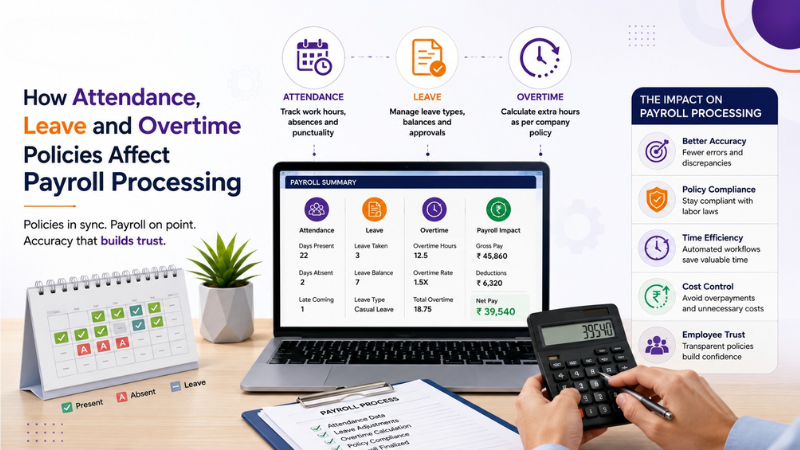
6. Accurate Overtime Tracking Is Essential
Manually calculating overtime can be challenging, especially for businesses with multiple shifts or large workforces.
HR teams may need to compare:
- Scheduled working hours
- Actual working hours
- Approved overtime
- Overtime rates
- Employee eligibility
Even a small calculation error can affect salary processing.
How PAYDAY Helps
PAYDAY can connect attendance information with payroll so that relevant working-hour and overtime information can be considered during salary processing.
This reduces repetitive calculations and gives HR teams better visibility into employee working hours.
7. Attendance + Leave + Overtime = Payroll Accuracy
Attendance, leave, and overtime should not be treated as completely separate HR processes.
They are interconnected.
For example:
Attendance determines the employee's working record.
↓
Leave Management records approved absences.
↓
Overtime records additional working hours.
↓
Payroll uses the relevant information to calculate salary.
This interconnected workflow can help businesses improve payroll accuracy and reduce manual HR work.
How the Three Policies Work Together
|
HR Policy |
Information Generated |
Payroll Impact |
|
Attendance Policy |
Present/Absent Days |
Salary calculation |
|
Leave Policy |
Paid/Unpaid Leave |
Leave adjustment |
|
Overtime Policy |
Extra Working Hours |
Overtime payment |
|
Payroll Policy |
Salary Rules |
Final Salary |
A well-integrated HR system brings these processes together.
8. Payroll Cut-Off Dates Keep Processing Organized
A payroll cut-off date defines when attendance, leave, and overtime information must be finalized for a particular payroll cycle.
For example, a company may establish a specific date each month after which attendance corrections or leave approvals are carried forward to the next payroll cycle, according to its policy.
A clear cut-off policy helps HR teams:
- Finalize attendance
- Approve pending leave
- Verify overtime
- Review deductions
- Process payroll on time
PAYDAY can help HR teams manage payroll-related information through centralized records and reports.
9. Clear Policies Reduce Employee Disputes
Employees may question salary calculations when they don't understand how attendance, leave, or overtime affects their pay.
For example:
"Why was my salary reduced?"
"Why wasn't my overtime included?"
"Why was this leave treated as unpaid?"
A clear written policy helps employees understand the rules before these situations occur.
Businesses should communicate their policies clearly and make them easily accessible to employees.
PAYDAY's employee-focused HR workflows can support greater transparency by giving employees access to relevant HR information and records.
10. Manual Payroll Processing Creates More Work for HR
When attendance, leave, overtime, and payroll are maintained in separate spreadsheets or systems, HR teams may need to repeatedly enter the same information.
This can lead to:
- Duplicate data
- Calculation errors
- Delayed payroll
- Difficult record management
- Increased administrative workload
As the organization grows, manual processes become increasingly difficult to maintain.
11. How PAYDAY Connects Attendance, Leave and Payroll
PAYDAY HRMS brings multiple HR processes together within one platform.
Attendance Management
Track employee attendance and working information.
Leave Management
Manage leave applications, approvals, balances, and leave records.
Payroll Management
Process salaries using relevant employee and attendance information.
Employee Management
Maintain centralized employee records.
Reports & Analytics
Generate reports for attendance, leave, payroll, and workforce information.
Recruitment & Onboarding
Manage the employee journey before and after joining.
Letter Management
Create and manage important employee-related documents.
GIS Tracking
Support location-based workforce and attendance management where applicable.
This interconnected approach allows businesses to manage HR operations without treating each process as an isolated activity.
12. The Role of HR Reports in Payroll Management
Reports are important for reviewing payroll information before final processing.
HR teams may need to review:
- Attendance reports
- Leave reports
- Overtime information
- Salary reports
- Employee records
- Deduction information
PAYDAY provides reporting capabilities that help HR teams access relevant workforce and payroll information from a centralized system.
These reports can help identify inconsistencies before payroll is finalized.
13. How Businesses Can Create Better Payroll Policies
A good payroll policy should be clear, consistent, and communicated to employees.
Step 1: Define Working Hours
Clearly establish standard working hours, shifts, and attendance requirements.
Step 2: Define Leave Rules
Specify available leave types, eligibility, approval procedures, and how unpaid leave is handled.
Step 3: Establish Overtime Rules
Define eligibility, approval procedures, working-hour requirements, and payment treatment in accordance with applicable laws and company policy.
Step 4: Set Payroll Cut-Off Dates
Specify deadlines for attendance corrections, leave approvals, overtime approvals, and payroll inputs.
Step 5: Define Salary Processing Rules
Clearly document salary calculation, deductions, benefits, bonuses, arrears, and other applicable components.
Step 6: Communicate the Policy
Employees and managers should understand the rules that affect their attendance, leave, overtime, and salary.
Step 7: Use Integrated HR Software
A centralized HRMS can help businesses apply and manage these processes more consistently.
Benefits of Connecting Attendance, Leave and Payroll
An integrated approach can help businesses achieve:
1. Better Payroll Accuracy
Payroll teams can work with more consistent attendance and leave information.
2. Reduced Manual Work
HR teams don't have to repeatedly transfer information between systems.
3. Faster Payroll Processing
Centralized data can reduce the time required to prepare monthly payroll.
4. Greater Employee Transparency
Employees can better understand their attendance, leave, and salary information.
5. Improved HR Productivity
HR professionals can spend less time on repetitive administrative tasks.
6. Better Workforce Insights
Reports help management understand workforce patterns.
Why PAYDAY HRMS Is a Suitable Solution for Growing Businesses
As businesses grow, managing HR processes through spreadsheets and disconnected systems becomes increasingly difficult.
PAYDAY HRMS connects important HR functions such as:
Recruitment → Onboarding → Employee Management → Attendance → Leave → Payroll → Reports
Additional capabilities such as GIS Tracking, Letter Management, Multi-Location Management, and HR Reports help businesses manage a wider range of workforce requirements from one platform.
Instead of managing attendance, leave, overtime, employee records, and payroll separately, businesses can create a more connected HR workflow with PAYDAY.
Frequently Asked Questions
1. How does attendance affect payroll processing?
Attendance records can affect salary calculations through factors such as absences, half-days, working hours, and other company-defined attendance rules.
2. Does leave affect employee salary?
It depends on the organization's leave policy and whether the leave is paid or unpaid. Businesses should clearly document their leave rules.
3. Why is an overtime policy important?
An overtime policy establishes clear rules around eligibility, approval, working hours, and payment, helping reduce confusion and disputes.
4. Can attendance and leave be integrated with payroll?
Yes. An integrated HRMS can connect attendance and leave information with payroll processing, reducing repetitive data entry and manual calculations.
5. How can PAYDAY help with payroll processing?
PAYDAY HRMS connects employee management, attendance, leave, payroll, and reporting within one platform, helping businesses manage payroll-related HR information more efficiently.
6. Why should businesses have separate attendance, leave, and payroll policies?
Each policy addresses a different HR process, but they should be designed to work together so that employees and HR teams clearly understand how attendance, leave, and overtime affect salary processing.
Conclusion
Attendance, Leave and Overtime Policies play an important role in accurate and consistent payroll processing. When these policies are unclear or managed through disconnected systems, businesses may experience payroll errors, processing delays, and employee disputes.
A well-defined approach connects attendance records, approved leave, overtime information, and payroll rules into one consistent workflow.
With PAYDAY HRMS, businesses can connect Attendance Management, Leave Management, Payroll, Employee Management, and Reports while also managing recruitment, onboarding, letters, GIS tracking, and multi-location workforce operations.
For growing businesses, combining clear HR policies with integrated technology can create a more accurate, transparent, and efficient payroll process.
Make Payroll Processing More Accurate with PAYDAY HRMS
Manage attendance, leave, overtime, employee records, and payroll from one integrated HR platform.
Book a Free Demo and discover how PAYDAY HRMS can help your HR team manage workforce processes more efficiently.


